
What Is Electronics? A Beginner-Friendly Introduction
Learn what electronics is, how circuits work, why semiconductors matter, and how electronics powers phones, computers, embedded systems and more
Electronics is the field of technology that deals with controlling electric charge to do useful work.
That may sound abstract, but electronics is everywhere around you. Your smartphone, laptop, charger, Wi-Fi router, television, smartwatch, car, washing machine, headphones, medical devices, satellites, robots, and data centers all depend on electronics.
At a very basic level, electronics is about making electricity behave in a controlled way. Sometimes we use electricity to power something, like lighting an LED or driving a motor. Sometimes we use it to carry information, like a microphone converting sound into an electrical signal. Sometimes we use it to make decisions, like a microcontroller checking a temperature sensor and turning on a fan. At the most advanced level, electronics becomes chip design, where billions of tiny transistors are arranged inside a processor, memory chip, sensor, or AI accelerator.
Electronics matters because it forms the physical foundation of modern computing, communication, automation, control systems, consumer devices, industrial machines, medical systems, and semiconductor technology. Software may feel like the visible part of modern technology, but software always runs on electronic hardware.
To understand electronics properly, you need to understand more than just wires and batteries. You need to understand circuits, signals, components, semiconductors, timing, power, noise, logic, firmware, printed circuit boards, and eventually integrated circuits.
This article starts from absolute beginner intuition and gradually moves into engineering-level understanding.
The Beginner Explanation
A simple way to understand electronics is to think of electricity like water flowing through pipes.
A battery is like a water pump. It creates pressure that pushes electric charge through a circuit. This electrical “pressure” is called voltage.
The moving electric charge is like flowing water. This flow is called current.
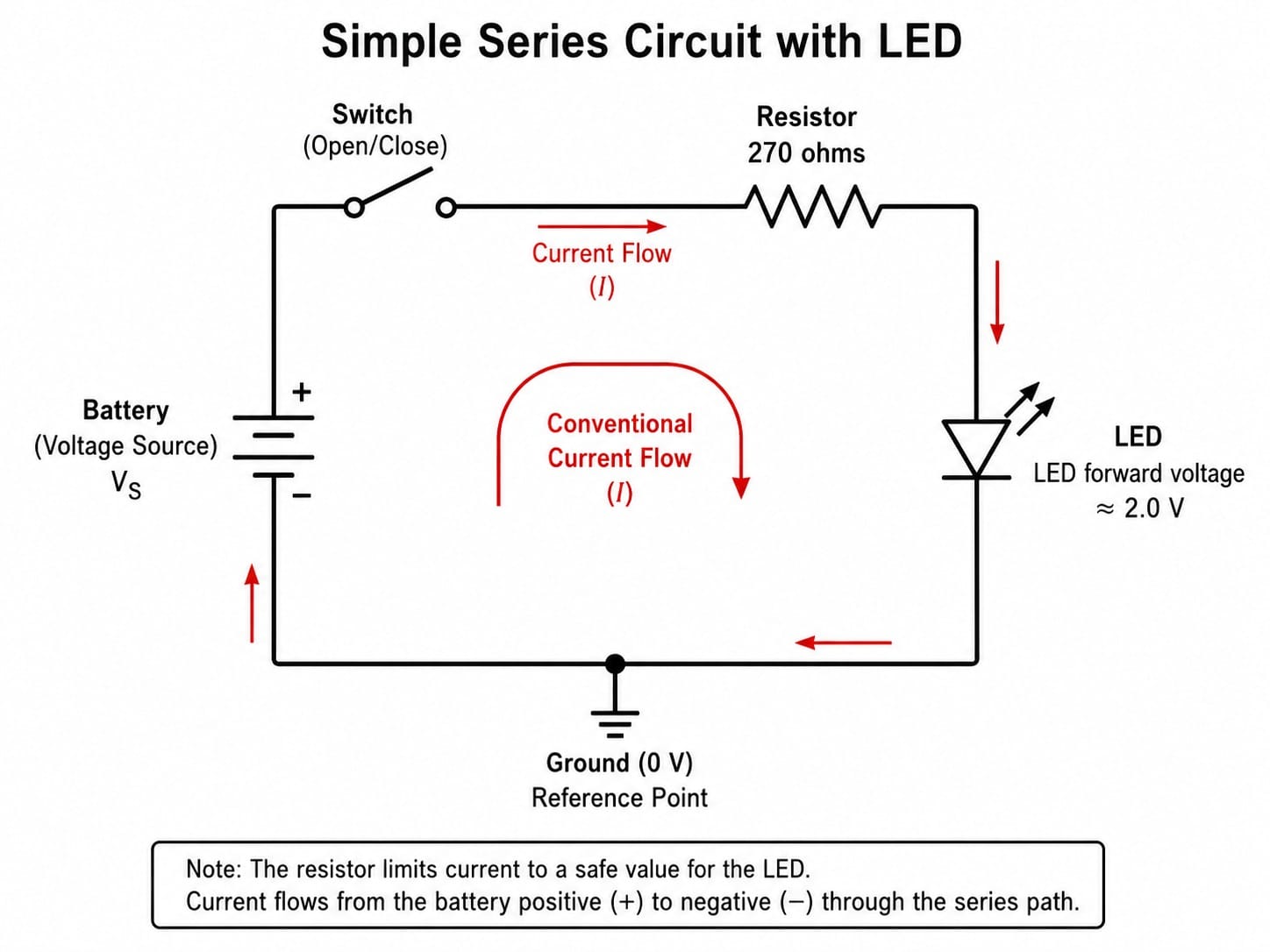
A resistor is like a narrow pipe that limits the flow. It does not stop electricity completely, but it makes it harder for current to pass.
A switch is like a valve. When it is open, current cannot flow. When it is closed, current can flow.
An LED is like a small device that glows when current flows through it in the correct direction.
So a very simple electronic circuit can be imagined like this:
Battery → Switch → Resistor → LED → Back to battery
When the switch is closed, the battery pushes current through the resistor and LED. The resistor protects the LED by limiting current. The LED converts some electrical energy into light.
That is already electronics.
But electronics becomes much more powerful when circuits are used not just to move energy, but to represent and process information.
For example:
- A microphone converts air pressure changes into voltage changes.
- A temperature sensor converts heat into an electrical signal.
- A button converts a human action into a digital input.
- A processor uses billions of transistor switches to perform calculations.
- A radio circuit turns electromagnetic waves into useful data.
- A camera sensor converts light into electrical charge.
So electronics is not only about electricity. It is about using electricity as a controllable physical language.
Core Technical Explanation
Technically, electronics is the study and engineering of circuits that control the movement of electrons and other charge carriers through materials and components.
In electrical engineering, there is a useful distinction between electrical systems and electronic systems.
Electrical systems often focus on power generation, transmission, motors, transformers, and large-scale energy delivery. Electronic systems usually focus on controlling signals, processing information, switching, amplification, sensing, computation, and low-to-medium power control.
The boundary is not strict. A modern electric vehicle, for example, contains both heavy electrical power systems and advanced electronics.
At the heart of electronics are three major ideas:
1. Circuits
A circuit is a closed path through which current can flow. A circuit usually contains a source, conductors, components, and a return path.
The most basic electrical relationship is Ohm’s Law:
\[V = IR\]
Where:
- V is voltage in volts.
- I is current in amperes.
- R is resistance in ohms.
This equation tells us that current depends on voltage and resistance:
\[I = \frac{V}{R}\]
If you connect a 5 V supply across a 1 kΩ resistor:
\[I = \frac{5}{1000} = 0.005,A = 5,mA\]
That simple calculation is used constantly in electronics.
2. Components
Electronic circuits are built from components. Some components are passive, meaning they do not amplify or actively control energy. Examples include resistors, capacitors, and inductors.
Other components are active, meaning they can control current flow, amplify signals, or switch states. Examples include diodes, transistors, operational amplifiers, voltage regulators, microcontrollers, and integrated circuits.
The transistor is the most important active device in modern electronics. It can behave like a switch or amplifier. Digital chips use transistors as tiny switches. Analog circuits often use transistors to amplify or shape signals.
3. Signals
A signal is a voltage or current that carries information.
Signals can be analog or digital.
An analog signal varies continuously. Audio from a microphone is a good example. The voltage rises and falls smoothly according to sound pressure.
A digital signal uses discrete levels, usually interpreted as 0 and 1. A microcontroller input pin may treat 0 V as logic 0 and 3.3 V as logic 1.
Digital electronics is built from logic gates, flip-flops, memory cells, processors, and communication buses. Analog electronics deals with real-world signals, amplification, filtering, sensing, power regulation, and conversion between physical quantities and electrical signals.
Most real systems use both.
A smartphone, for example, contains analog RF circuits, digital processors, power management circuits, memory, sensors, display drivers, audio circuits, battery charging electronics, and semiconductor chips with billions of transistors.
Important Terms You Should Know
Voltage
Voltage is the electric potential difference between two points. It is what pushes charge through a circuit. Voltage is measured in volts.
Current
Current is the rate of flow of electric charge. It is measured in amperes.
Resistance
Resistance opposes current flow. It is measured in ohms.
Power
Power is the rate at which electrical energy is used or transferred.
\[P = VI\]
A 5 V circuit drawing 0.2 A consumes:
\[P = 5 \times 0.2 = 1,W\]
Ground
Ground is the reference point in a circuit. It is often treated as 0 V, but it does not always mean earth ground. Many beginner mistakes come from misunderstanding ground as an absolute universal voltage.
Signal
A signal is an electrical quantity that carries information. It can be voltage, current, charge, or electromagnetic energy.
Analog
Analog electronics deals with continuous signals. Examples include audio, sensor voltages, RF signals, and power supply ripple.
Digital
Digital electronics deals with discrete logic levels, usually binary 0 and 1.
Semiconductor
A semiconductor is a material whose conductivity can be controlled. Silicon is the most widely used semiconductor material.
Diode
A diode allows current to flow mainly in one direction. LEDs are diodes that emit light.
Transistor
A transistor controls current flow. It can work as a switch or amplifier. Transistors are the building blocks of modern chips.
Integrated Circuit
An integrated circuit, or IC, is a circuit fabricated on a tiny semiconductor chip. Examples include microcontrollers, processors, memory chips, sensors, and power management chips.
PCB
A printed circuit board, or PCB, is a board that mechanically supports and electrically connects electronic components using copper traces.
Firmware
Firmware is low-level software that runs directly on hardware, such as microcontrollers, sensors, and embedded devices.
How It Works Step by Step
Let us break down how electronics works in a typical system.
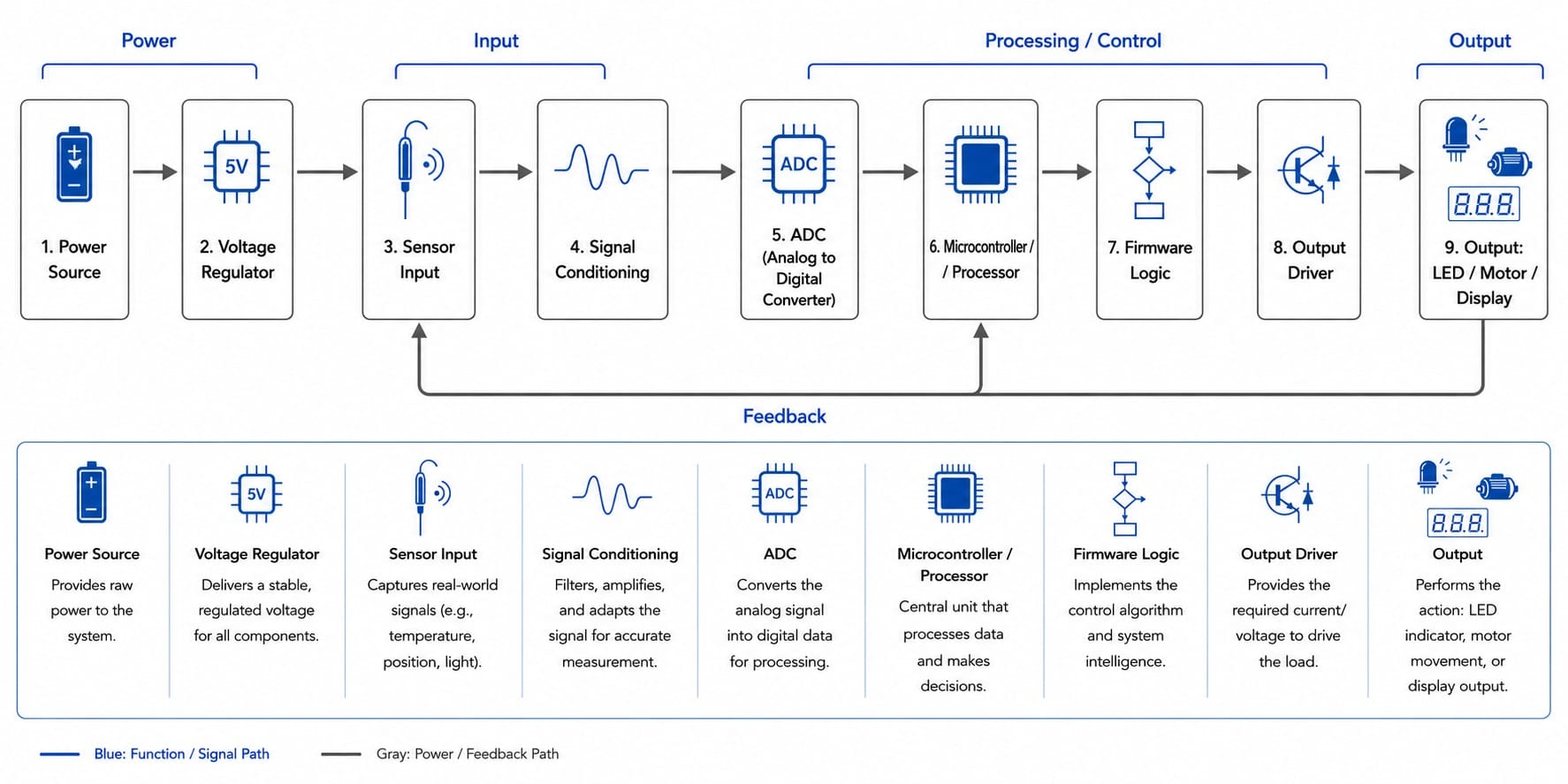
1. A power source provides energy
Every electronic system needs power. This may come from a battery, USB supply, wall adapter, solar panel, power supply unit, or energy harvesting circuit.
The power source provides voltage, and the circuit draws current depending on its design and load.
2. Power is regulated
Most electronic components need specific voltages. A microcontroller may need 3.3 V. A sensor may need 1.8 V. A motor may need 12 V. A processor core may need less than 1 V.
Voltage regulators convert one voltage level to another. Linear regulators are simple but less efficient. Switching regulators are more efficient but more complex and noisier.
3. Inputs are sensed
The system receives information from the outside world.
Inputs may come from:
- Buttons
- Temperature sensors
- Light sensors
- Microphones
- Cameras
- Accelerometers
- Touchscreens
- Radio antennas
- Network interfaces
These inputs are converted into electrical signals.
4. Signals are conditioned
Raw signals are often noisy, weak, or unsuitable for direct processing. Analog circuits may amplify, filter, shift, or protect these signals.
For example, a temperature sensor voltage may be filtered before it enters an analog-to-digital converter.
5. Signals are converted if needed
Many physical signals are analog, but processors work digitally. An analog-to-digital converter, or ADC, converts analog voltage into digital numbers.
For output, a digital-to-analog converter, or DAC, can convert digital values back into analog signals.
6. Logic or processing happens
A digital circuit, microcontroller, FPGA, or processor processes the information.
This may involve simple logic, such as:
“If temperature is above 40°C, turn on fan.”
Or complex computation, such as:
- Running an operating system
- Processing camera images
- Performing AI inference
- Encoding wireless data
- Controlling a motor
- Encrypting network traffic
7. Outputs are controlled
The system then creates an output.
Outputs may include:
- LEDs
- Displays
- Motors
- Speakers
- Relays
- Wireless transmissions
- Memory writes
- Network packets
- Actuator movement
8. Feedback improves control
Many electronic systems use feedback. A power supply monitors its output voltage and adjusts itself. A thermostat measures temperature and controls heating. A motor controller measures speed and adjusts drive current.
Feedback is one reason electronics can create precise, automatic control systems.
Real-World Applications
Electronics is used almost everywhere in modern technology.
Consumer Electronics
Smartphones, laptops, tablets, televisions, headphones, cameras, gaming consoles, chargers, and smartwatches all depend on electronic circuits. These devices combine processors, memory, sensors, displays, wireless chips, batteries, and power management circuits.
Embedded Systems
An embedded system is a computer built into a larger product. Examples include washing machines, routers, printers, drones, smart meters, industrial controllers, medical devices, and automotive control units.
Embedded systems usually combine hardware and firmware.
Computers and Servers
Processors, GPUs, RAM, SSDs, network cards, power supplies, and motherboards are all electronic systems. At the chip level, computers are massive networks of transistors switching billions of times per second.
Smartphones
A smartphone is one of the densest examples of modern electronics. It contains RF front-end modules, antennas, application processors, memory, display drivers, image sensors, audio codecs, power management ICs, battery charging circuits, security chips, and many sensors.
IoT Devices
Internet of Things devices use electronics to sense, compute, communicate, and control. A smart thermostat, for example, may include a temperature sensor, microcontroller, Wi-Fi chip, power supply, display, and relay driver.
Automotive Electronics
Modern cars use electronics for engine control, battery management, infotainment, braking systems, radar, cameras, airbags, lighting, steering assistance, and advanced driver-assistance systems.
Electric vehicles add high-power electronics such as inverters, battery management systems, onboard chargers, and DC-DC converters.
Semiconductor Systems
Semiconductor chips are electronics at microscopic scale. A processor, memory chip, image sensor, RF transceiver, or power management IC is an electronic circuit fabricated inside silicon.
VLSI design, chip verification, semiconductor manufacturing, packaging, and testing are all advanced areas built on electronics fundamentals.
Engineering-Level Details
At engineering level, electronics is not just “connecting components.” It is about designing predictable electrical behavior under real-world constraints.
Circuit Laws
Two fundamental laws are Kirchhoff’s Voltage Law and Kirchhoff’s Current Law.
Kirchhoff’s Voltage Law says the sum of voltages around a closed loop is zero:
\[\sum V = 0\]
Kirchhoff’s Current Law says the sum of currents entering a node equals the sum of currents leaving it:
\[\sum I_{in} = \sum I_{out}\]
These laws are used in circuit analysis, simulation, PCB debugging, and IC design.
RC Timing Behavior
Many circuits contain resistors and capacitors. A capacitor stores energy in an electric field. When charged through a resistor, the voltage follows an exponential curve:
\[V_C(t) = V_{supply}\left(1 - e^{-t/RC}\right)\]
The term RC is called the time constant:
\[\tau = RC\]
After one time constant, the capacitor charges to about 63.2% of the supply voltage. RC behavior appears in filters, reset circuits, timing circuits, debounce circuits, power sequencing, and signal integrity.
Digital Logic
Digital electronics uses voltage levels to represent binary states. A logic 0 may be near 0 V, and a logic 1 may be near 3.3 V, but the exact thresholds depend on the logic family.
A CMOS inverter is one of the most important digital building blocks. It uses a PMOS transistor connected to the supply and an NMOS transistor connected to ground. When the input is low, the PMOS turns on and the output goes high. When the input is high, the NMOS turns on and the output goes low.
This basic structure scales into gates, flip-flops, registers, adders, SRAM, processors, and system-on-chip designs.
Semiconductor Physics
Semiconductors work because their conductivity can be controlled through doping and electric fields.
Pure silicon is not a great conductor. By adding controlled impurities, engineers create n-type and p-type regions.
- n-type silicon has extra electrons as majority carriers.
- p-type silicon has holes as majority carriers.
A diode is formed by joining p-type and n-type material. A MOSFET transistor uses an electric field at the gate terminal to control current between source and drain.
The simplified MOSFET current behavior depends on operating region, but the key idea is that gate voltage controls channel conductivity. This allows transistors to act as switches in digital circuits and controlled current devices in analog circuits.
Power and Thermal Design
Every real circuit consumes power and produces heat.
The basic power equation is:
\[P = VI\]
For resistors:
\[P = I^2R\]
In digital CMOS circuits, dynamic power is often approximated by:
\[P_{dynamic} = \alpha C V^2 f\]
Where:
- α is the switching activity factor.
- C is capacitance.
- V is supply voltage.
- f is clock frequency.
This equation explains why lowering voltage is so important in modern chips. Power scales with the square of voltage.
Signal Integrity
At low speed, a PCB trace may behave like a simple wire. At high speed, it behaves like a transmission line. Fast digital edges can create reflections, ringing, crosstalk, ground bounce, and electromagnetic interference.
For high-speed interfaces such as USB, PCIe, DDR memory, HDMI, Ethernet, and RF circuits, PCB layout becomes part of the circuit. Trace impedance, return paths, termination, differential pairs, via stubs, and layer stackup all matter.
Firmware and Hardware Interaction
Electronics is often controlled by firmware. A microcontroller reads registers, configures pins, samples ADC channels, controls PWM outputs, communicates over I2C or SPI, and handles interrupts.
For example, blinking an LED is not just a software task. It involves:
- GPIO pin configuration
- Output driver transistor behavior
- LED forward voltage
- Current-limiting resistor
- Power supply stability
- Firmware timing
- PCB routing
Good engineers understand both hardware and software behavior.
Common Mistakes and Misconceptions
“Voltage flows through a circuit”
Voltage does not flow. Current flows. Voltage is a potential difference that pushes current.
“Ground is always zero volts everywhere”
Ground is a reference point, but real ground traces have resistance and inductance. In high-current or high-speed circuits, different ground points can have slightly different voltages.
“Digital signals are perfect square waves”
Real digital signals have rise time, fall time, noise, overshoot, undershoot, ringing, and timing uncertainty. Digital electronics still depends on analog behavior.
“A bigger power supply always forces more current”
A load draws current depending on its resistance or active behavior. A 5 V, 2 A power supply does not force 2 A through every circuit. It can supply up to 2 A if the circuit demands it.
“All capacitors are the same”
Capacitors have capacitance, voltage rating, equivalent series resistance, leakage, tolerance, temperature behavior, and frequency characteristics. A 10 µF ceramic capacitor and a 10 µF electrolytic capacitor may behave very differently.
“Microcontrollers are just small computers”
A microcontroller is a computer, but it is designed for direct hardware control. It usually includes GPIO, timers, ADCs, communication peripherals, flash memory, RAM, and low-power modes on one chip.
“PCB layout is only about connecting points”
PCB layout affects noise, heat, signal integrity, electromagnetic interference, manufacturability, reliability, and safety. The physical arrangement of copper matters.
Practical Example
Let us design a simple LED circuit controlled by a microcontroller.
Suppose we have:
- Microcontroller GPIO voltage: 3.3 V
- LED forward voltage: approximately 2.0 V
- Desired LED current: 5 mA
We need a resistor in series with the LED to limit current.
The resistor must drop the remaining voltage:
\[V_R = 3.3,V - 2.0,V = 1.3,V\]
Using Ohm’s Law:
\[R = \frac{V}{I}\]
\[R = \frac{1.3}{0.005} = 260,\Omega\]
A standard resistor value close to this is 270 Ω.
Now calculate resistor power:
\[P = I^2R\]
\[P = (0.005)^2 \times 270 = 0.00675,W\]
That is about 6.75 mW, so a common 0.125 W or 0.25 W resistor is more than enough.
A simple Arduino-style code example:
// Simple LED blink example
// Assumes LED is connected to GPIO pin 13 through a current-limiting resistor

#define LED_PIN 13

void setup() {
    // Configure the GPIO pin as a digital output
    pinMode(LED_PIN, OUTPUT);
}

void loop() {
    // Turn LED on
    digitalWrite(LED_PIN, HIGH);
    delay(500);

    // Turn LED off
    digitalWrite(LED_PIN, LOW);
    delay(500);
}
What is really happening?
The firmware configures the pin as an output. Internally, transistor drivers inside the microcontroller connect the pin either toward the supply or toward ground. When the output is high, current flows from the GPIO pin through the resistor and LED, causing light emission. When the output is low, the voltage across the LED is not enough to conduct significantly, so it turns off.
This small example connects many electronics concepts: voltage, current, resistance, semiconductor behavior, firmware, GPIO, power, and component selection.
Comparison Table
| Area | What It Deals With | Common Components | Example |
|---|---|---|---|
| Basic Electronics | Voltage, current, resistance, simple circuits | Resistors, LEDs, switches, batteries | LED flashlight circuit |
| Analog Electronics | Continuous signals | Op-amps, filters, ADC front ends, sensors | Microphone amplifier |
| Digital Electronics | Binary logic and switching | Logic gates, flip-flops, counters | Processor logic circuit |
| Power Electronics | Efficient power conversion and control | MOSFETs, inductors, regulators, converters | Laptop charger, EV inverter |
| Embedded Electronics | Hardware controlled by firmware | Microcontrollers, sensors, GPIO, timers | Smart thermostat |
| RF Electronics | High-frequency wireless signals | Antennas, mixers, filters, LNAs | Wi-Fi or 5G radio |
| Semiconductor Electronics | Devices fabricated on chips | Diodes, MOSFETs, CMOS gates | CPU, GPU, memory chip |
| PCB Design | Physical circuit implementation | Copper traces, vias, planes, connectors | Smartphone motherboard |
Why This Matters in Modern Technology
Electronics is the bridge between the physical world and digital technology.
A software application can process images, but an image sensor must first convert photons into electrical charge. An AI model can run on a GPU, but the GPU is made from billions of transistors switching under strict timing and power limits. A smartphone app can send a message, but RF electronics must convert digital data into electromagnetic waves. An electric vehicle can run advanced control algorithms, but power electronics must drive motors safely and efficiently.
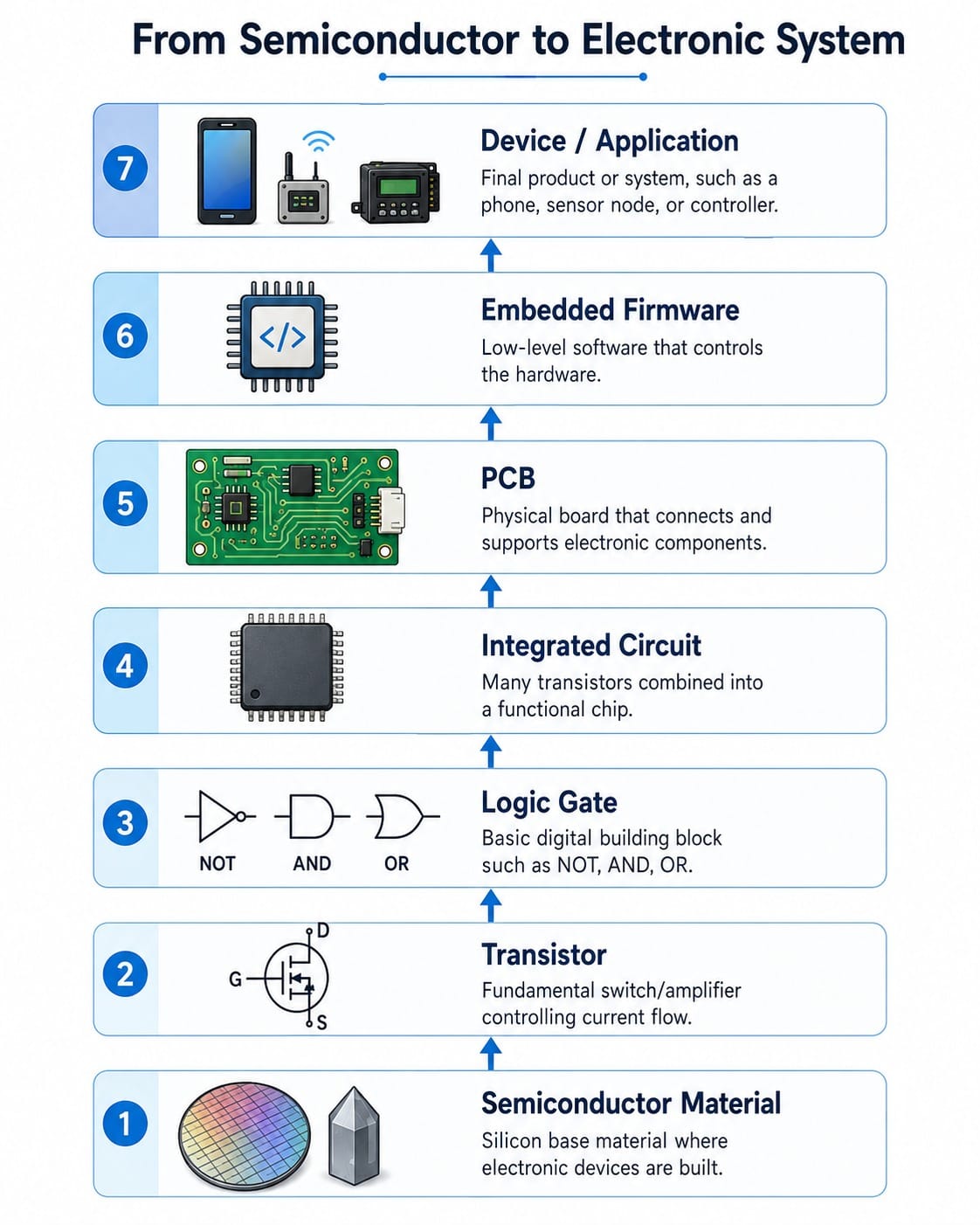
Modern technology depends on many layers:
- Materials and semiconductor physics
- Transistor design
- Circuit design
- Logic design
- Chip architecture
- PCB design
- Firmware
- Operating systems
- Applications
- Cloud systems
Electronics sits near the bottom of this stack. It is where abstract computation becomes physical reality.
For semiconductor learners, electronics explains why chips work. For embedded developers, it explains why firmware interacts with real pins, voltages, timing, and noise. For PCB learners, it explains why layout is not just drawing connections. For hobbyists, it turns trial-and-error projects into understandable systems. For engineering students, it becomes the foundation for analog design, digital design, communication systems, control systems, power systems, robotics, and VLSI.
Understanding electronics does not mean memorizing every component. It means learning how electrical behavior, information, energy, materials, and computation fit together.
Summary
Electronics is the science and engineering of controlling electric charge to process information, transfer energy, sense the environment, and build intelligent systems.
At beginner level, electronics starts with voltage, current, resistance, switches, LEDs, and simple circuits. At intermediate level, it expands into analog signals, digital logic, sensors, microcontrollers, power regulation, and PCB design. At engineering level, it includes semiconductor physics, transistor behavior, signal integrity, timing, firmware interaction, chip design, power consumption, and system architecture.
The most important idea is that electronics is not only about components. It is about controlled electrical behavior. Every modern device, from a small sensor node to a smartphone processor or AI accelerator, is built on this foundation.
FAQs
1. What is electronics in simple words?
Electronics is the field of using controlled electricity to build useful devices. It includes circuits that power, sense, process, store, transmit, or display information.
2. Is electronics different from electrical engineering?
Yes, but they overlap. Electrical engineering often includes large-scale power systems, motors, and energy distribution. Electronics focuses more on circuits, signals, semiconductors, computation, control, and devices.
3. Do I need math to learn electronics?
You can start with very little math, but basic algebra becomes important quickly. Ohm’s Law, power equations, RC timing, filters, and digital logic all require some math. Advanced electronics uses calculus, differential equations, linear algebra, and semiconductor physics.
4. What should beginners learn first in electronics?
Start with voltage, current, resistance, Ohm’s Law, LEDs, resistors, capacitors, switches, breadboards, multimeters, and simple circuits. Then move into transistors, sensors, microcontrollers, analog signals, digital logic, and PCB design.
5. Why are semiconductors so important in electronics?
Semiconductors allow engineers to control current at tiny scales. Diodes, transistors, integrated circuits, processors, memory chips, sensors, and power devices all depend on semiconductor materials such as silicon.